Target Company URL Research: A Practical Guide to Finding and Verifying Company Websites

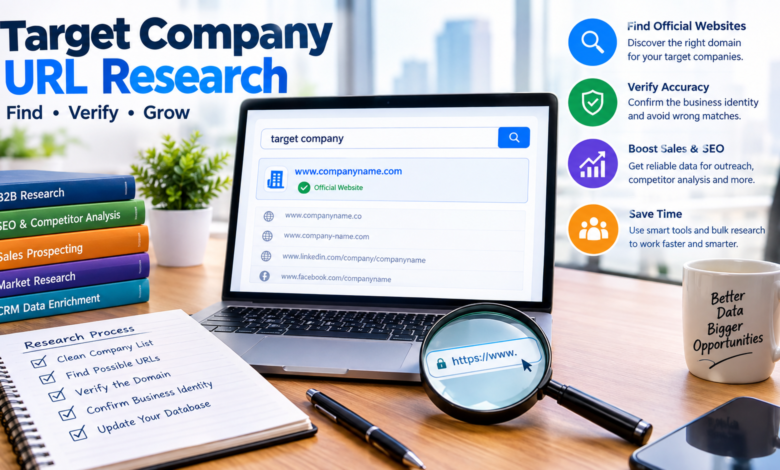
Target Company URL Research When you have a list of companies to research, one of the first things you usually need is the correct website. That sounds easy when you are dealing with famous brands, but it becomes much harder when the list contains hundreds of businesses, unfamiliar companies, local organizations, startups, or companies with similar names. This is where target company URL research becomes useful.
Target company URL research is the process of identifying the official website or primary domain associated with a particular business. It is commonly useful in sales prospecting, SEO research, recruitment, market analysis, competitor research, and CRM data management. A company name alone does not always provide enough information to identify the correct business, so researchers need a structured way to find and verify the right URL.
The important part is not simply finding a website that contains the same words as the company name. Good research means confirming that the website actually belongs to the intended company. This article explains how the process works, why it matters, common mistakes to avoid, and how you can make company URL research faster and more reliable.
What Is Target Company URL Research?
In simple terms, target company URL research means finding the official website of a company that you want to investigate, contact, evaluate, or add to a business database.
For example, imagine that you have a spreadsheet containing 300 company names. The spreadsheet may have columns for company name, industry, location, and contact person, but the website column is empty. Instead of searching for every company separately, you can use a structured URL research process to identify the likely domains and then verify them.
The process normally looks something like this:
Company name → Possible website → Verification → Confirmed domain → Further research
This distinction is important because search engines can return many different types of results. You might find a social media account, business directory, review page, news article, subsidiary, or completely unrelated company before finding the actual official website. Researchers therefore need to confirm the identity of the business rather than simply choosing the first result.
Target company URL research is especially useful when working with large lists. Sales teams may need websites before starting outreach, recruiters may need official employer websites, and SEO professionals may need domains for competitor or backlink research. Once the correct domain is known, much deeper research becomes possible.
Why Is Finding the Correct Company URL Important?
The website is often the foundation of company research. Once you have the correct domain, you can investigate the company’s products, services, leadership information, locations, careers, contact details, content strategy, and other publicly available information.
A wrong URL can create a surprisingly large problem. If two businesses have similar names and you accidentally select the wrong website, every piece of research collected afterward may also be wrong. A sales representative could contact the wrong company, a recruiter could investigate the wrong employer, or an SEO professional could add the wrong competitor to a database.
Accuracy is therefore more important than simply finding a URL quickly. Target Company URL Research A useful research workflow should balance speed with verification. Automated systems can help discover possible domains, but uncertain matches should still receive additional attention. Current guides on company URL research similarly emphasize checking business identity, industry, location, products, and other signals before accepting an important match.
Another advantage is organization. When every company record contains a verified domain, teams can maintain cleaner CRM databases and perform future research much more efficiently. A small improvement in URL accuracy can save significant time when the same database is used repeatedly.
How to Start Target Company URL Research
The first step is to create a clean list of the companies you want to investigate. Ideally, each row should contain one company name without unnecessary information mixed into the field.
For example, instead of entering:
ABC Technology Ltd – London – Software Company
you could keep the company field as:
ABC Technology
The location and industry can remain in separate columns. This makes matching easier and gives you additional information that can later be used to resolve ambiguous results.
The next step is to remove duplicates. Large spreadsheets often contain the same company multiple times because different employees, departments, or data sources have added the business separately. Target Company URL Research Cleaning these records before research can reduce unnecessary work.
It can also help to standardize legal suffixes such as Ltd, LLC, Inc., GmbH, or PLC where appropriate. Some company URL lookup systems perform this type of cleaning automatically because the recognizable trading name can be easier to match than the full legal entity name.
Search for the Official Company Website
Once the company list is clean, you can begin looking for the official websites. For a small number of companies, a normal search engine can be sufficient. Search the company name along with terms such as “official website,” the country, city, or industry.
For example, if several companies have the same name, adding geographic information can make the search much more precise. A query containing the company name and “Manchester” may produce very different results from a search containing the same company name and “New York.”
You should also examine the search result itself rather than relying only on the title. Visit the website and check whether the business identity matches what you already know.
For larger datasets, automated company-domain lookup tools can reduce repetitive manual searching. Target Company URL Research These systems generally accept a company name and return one or more possible domains, sometimes together with a matching or confidence score. Such tools can be particularly useful when dealing with dozens or hundreds of companies.
Verify the Domain Before Using It
Finding a possible domain is only half the job. The next step is verification.
Start by checking the company name on the website. Look at the homepage, About page, Contact page, footer, privacy policy, or legal information. These areas often contain details that help confirm whether the website belongs to the intended organization.
You should also compare the company’s industry and location. If your target is a software company based in London but the website you found represents a construction company in Australia with a similar name, the match is obviously questionable.
Products and services provide another strong verification signal. If the company in your spreadsheet sells accounting software but the website sells clothing, you have almost certainly found the wrong business.
For important records, it is useful to confirm several independent signals rather than relying on one similarity. Target Company URL Research A good checklist includes the company name, industry, location, products, contact information, corporate identity, and relationship to any parent or subsidiary company.
Dealing With Companies That Have Similar Names
Similar company names are one of the biggest challenges in target company URL research.
Consider a simple name such as “Atlas.” There could be software businesses, manufacturing companies, consulting firms, financial organizations, and local businesses using the same or similar name. A search system may return several plausible results.
The same issue happens with short names such as “Bolt,” “Mercury,” or “Summit.” A name match alone is not enough to establish the correct company.
When this happens, use additional context. Country, city, industry, product category, employee information, or a known contact can help narrow down the correct organization.
This is also where confidence scores should be interpreted carefully. A high name-match score may indicate that the company names are similar, but it does not necessarily prove that the domain belongs to your intended company. Automated matching can accelerate the process, but human verification remains valuable for ambiguous records.
Using Target Company URLs for SEO Research
SEO professionals can get considerable value from accurate company URLs. Once you know the correct domain, you can use it as the starting point for competitor research.
For example, you may want to examine a competitor’s content structure, important landing pages, categories, internal linking, search visibility, backlinks, or keyword targeting. None of that research is useful if you start with the wrong company website.
Domain research can also help when building a list of potential guest post opportunities, publishers, businesses, partners, or prospects. Target Company URL Research A clean company-to-domain database makes it easier to organize outreach campaigns and avoid contacting irrelevant websites.
Another useful application is competitor discovery. If you have a list of businesses operating in a specific industry, verifying their domains allows you to compare their online presence more systematically. You can then identify patterns in content, branding, website structure, and search strategy.
The key is to treat the URL as a reliable starting point rather than the complete research result. The domain tells you where the company’s official web presence is located, but additional analysis is still required to understand the business.
Target Company URL Research for Sales and Prospecting
Sales teams frequently begin with lists of target companies. Target Company URL Research However, a company name without a verified domain provides limited context.
Once the correct website is available, a salesperson can quickly understand what the business does, what products it offers, which industries it serves, and what type of customers it targets.
This information can make outreach more relevant. Instead of sending the same generic message to every prospect, sales professionals can understand the company’s business model and adapt their communication accordingly.
Accurate URLs also help maintain cleaner CRM records. When multiple sources contribute data to a CRM, inconsistent company names and missing domains can create duplicate records. Standardizing the company domain can make future research and database management easier.
Target Company URL Research for Recruitment
Recruiters can use the same approach when researching employers and organizations.
A candidate may mention an employer by a shortened trading name rather than its full legal name. Target Company URL Research Searching that name can sometimes produce several companies. Verifying the correct website helps recruiters understand the organization’s actual identity before continuing their research.
The official website can also lead to careers, jobs, About, leadership, and company-information pages. Some companies use dedicated subdomains or alternative paths for recruitment, so the main domain can serve as the starting point for locating those resources.
However, researchers should not assume that every company uses the same careers URL. Common patterns include /careers, /jobs, or dedicated careers subdomains, but businesses can use completely different structures. A careers-page finder can suggest possible paths, but the final page should still be checked manually.
Bulk Company URL Research
Manual research works well when you have five or ten companies. It becomes less attractive when your spreadsheet contains hundreds or thousands of records.
Bulk URL research allows multiple company names to be processed together. Depending on the tool, the results may include the submitted company name, matched company name, domain, and a confidence or match score.
This can dramatically reduce repetitive work. Instead of opening a search engine for every company, you can process the initial list in batches and focus your attention on uncertain matches.
However, bulk processing should not mean blindly accepting every result. High-confidence matches can often be processed quickly, while medium- and low-confidence records should be reviewed individually. Target Company URL Research This combination of automation and human verification offers a practical balance between speed and accuracy.
Common Mistakes in Company URL Research
One common mistake is choosing the first search result. Search engines do not always place the official company website at the top, especially for small businesses or companies with generic names.
Another mistake is ignoring geographic differences. A company may have a global domain plus regional websites. Researchers should determine which domain is relevant to the purpose of their research.
Old domains are another issue. Companies sometimes rebrand, merge, acquire other businesses, or move to a new domain. Target Company URL Research An older URL may redirect to the current website, while another may no longer represent the business.
Researchers should also avoid treating directories as official websites. Business directories can be helpful for discovering information, but the company’s own domain should normally be preferred when the objective is to identify the official online presence.
Finally, do not assume that an automated match is automatically correct. Even sophisticated lookup systems can struggle with common names, small companies, subsidiaries, and businesses that are missing from their underlying databases.
A Simple Target Company URL Research Checklist
Before marking a company URL as verified, use a short checklist.
Company identity: Does the website clearly represent the company you intended to research?
Industry: Does the business operate in the expected industry?
Location: Does its location match your target company?
Products or services: Are the products and services consistent with your original information?
Contact information: Does the website provide contact information that supports the match?
Legal information: Do the privacy, legal, or company pages identify the expected organization?
Domain status: Is the website active, or does the domain redirect to another official website?
Corporate structure: Is the website for the parent company, subsidiary, regional branch, or unrelated business?
If the answer to these questions is clear, you can be much more confident that the URL is correct.
How to Make the Research Process More Efficient
Efficiency comes from separating easy matches from difficult ones.
Start by cleaning the company list and removing duplicates. Target Company URL Research Then use an automated lookup process to generate possible domains. Sort the results according to confidence, and immediately verify the obvious high-quality matches.
After that, spend more time on ambiguous records. Add location, industry, country, or other known details to your searches when necessary.
It is also helpful to maintain a dedicated research spreadsheet with columns such as company name, verified domain, country, industry, verification status, source, and notes. This creates a record of why a particular domain was accepted.
For larger projects, you can even add a simple status system such as Verified, Needs Review, Not Found, and Possible Duplicate. This prevents uncertain results from accidentally being treated as confirmed information.
Final Thoughts
Target company URL research may look like a basic task, but it is an important part of reliable business research. A correct company domain provides the foundation for SEO analysis, sales prospecting, recruitment research, competitor analysis, market research, and CRM enrichment.
The most effective approach is not simply to search faster. It is to create a repeatable process that combines clean company data, efficient URL discovery, and careful verification.
For small lists, manual research may be enough. For larger lists, automated lookup tools can save significant time. Either way, the final responsibility remains the same: make sure the domain actually belongs to the company you intended to research.
When you consistently verify company URLs before using them, you reduce incorrect records, improve the quality of your research, and create a much stronger foundation for everything that comes next.
Frequently Asked Questions About Target Company URL Research
What does target company URL research mean?
Target company URL research is the process of finding and verifying the official website or domain associated with a company you want to research, contact, analyze, or evaluate.
Why is the official company URL important?
The official URL provides a reliable starting point for researching a company’s products, services, leadership, locations, careers, content, and other business information.
Can company URLs be researched in bulk?
Yes. Bulk lookup systems can process multiple company names and return possible domains. Target Company URL Research Uncertain matches should still be manually reviewed before being treated as verified.
Are automated company URL results always accurate?
No. Automated systems can struggle with generic company names, duplicate names, subsidiaries, rebranded businesses, regional websites, and small companies. Verification remains important.
What should I check before accepting a company URL?
Check the company name, industry, location, products or services, contact information, legal details, domain status, and corporate relationship. Multiple matching signals provide stronger confidence than a name match alone.
Can SEO professionals use target company URL research?
Yes. Verified domains can be used as starting points for competitor research, content analysis, backlink research, keyword analysis, and broader market research.


One Comment