Research Dossier for Target Company: A Complete Guide to Smarter Business Research

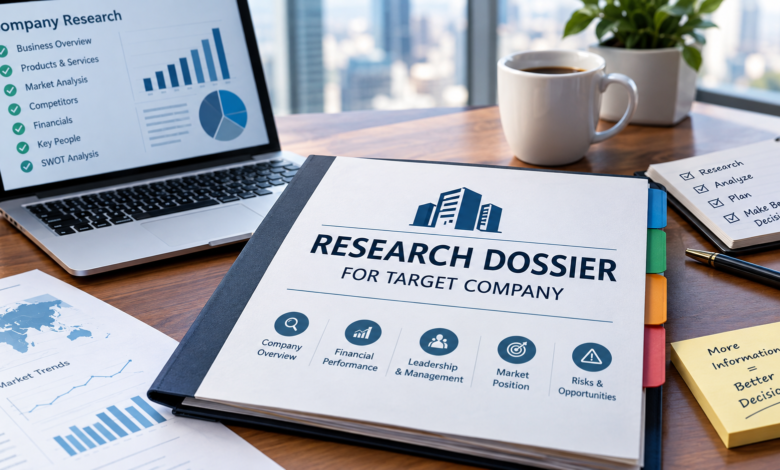
When people hear the phrase research dossier for target company, they may imagine a complicated corporate report filled with charts, financial figures, and technical language. In reality, a good research dossier is much more practical. Research Dossier for Target Company It is a structured collection of information that helps someone understand a company before making an important business decision.
Whether you are researching a potential client, supplier, competitor, investment opportunity, acquisition target, or business partner, reliable information can make a significant difference. Instead of relying on scattered details from different websites, a research dossier brings relevant information together in one organized document.
A well-prepared dossier can reveal how a company operates, who makes important decisions, what products or services it offers, how strong its market position is, and where potential opportunities or risks may exist. The goal is not simply to collect information but to turn information into useful business intelligence.
What Is a Research Dossier for Target Company?
A research dossier for target company is a detailed research document created to provide a clear overview of a specific organization. It usually combines publicly available business information, market research, company background, financial details, leadership information, competitors, products, reputation, and other relevant findings.
The exact contents can change depending on the purpose of the research. For example, a sales professional may focus on decision-makers, company needs, recent developments, and potential pain points. An investor may pay more attention to financial performance, ownership, market conditions, and risks.
The most important characteristic of a useful dossier is organization. Information should be arranged logically so that the reader can quickly understand the company without searching through dozens of separate sources.
A strong dossier should also distinguish between confirmed facts, reasonable analysis, and information that has not been independently verified. This helps prevent assumptions from being presented as facts.
Why Businesses Need a Company Research Dossier
Business decisions often involve uncertainty. A company may look attractive from the outside, but deeper research can reveal important information that is not immediately obvious. A research dossier helps reduce that uncertainty by creating a broader picture of the organization.
For sales teams, company research can improve outreach. Research Dossier for Target Company Instead of sending generic messages, representatives can understand the company’s industry, current priorities, products, and potential challenges. Research Dossier for Target Company This makes communication more relevant and can improve the quality of conversations with prospects.
A dossier can also help managers compare several companies consistently. When every target is researched using similar categories, it becomes easier to identify strengths, weaknesses, opportunities, and potential warning signs.
Key Information to Include in a Research Dossier
A useful dossier normally begins with basic company information. This may include the company’s legal name, trading name, headquarters, industry, website, founding year, business model, locations, and approximate company size.
The next section can cover products and services. Understanding what the company actually sells is essential because a business can have a very different market position from what its name or website initially suggests.
Leadership and ownership information can also be valuable. Research Dossier for Target Company Identifying executives, founders, department heads, and other important decision-makers provides context about how the company is managed. Research Dossier for Target Company However, personal information should only be included when it is relevant, publicly available, and appropriate for legitimate business research.
Another important category is the company’s market position. Research should examine competitors, target customers, geographic markets, unique selling points, and major industry trends. These details help explain where the company fits within its broader market.
How to Research a Target Company Effectively
Creating a reliable research dossier for target company starts with defining the research objective. Research Dossier for Target Company Before collecting information, determine exactly what you want to learn and why you need it.
For example, a company being evaluated as a potential supplier may require research into reliability, pricing, reputation, operational capacity, and customer feedback. A potential sales prospect may require more attention to its business model, technology stack, growth plans, and decision-makers.
After defining the objective, identify trustworthy sources. Company websites, official filings, regulatory databases, reputable news publications, industry reports, professional directories, and official announcements can all provide useful information.
It is important to compare information across multiple sources. A single webpage may contain outdated or incomplete information. Cross-checking important claims can significantly improve the accuracy of the final dossier.
Analyzing the Company’s Products and Services
Products and services are at the center of most businesses, so they deserve careful attention in a company research dossier. Research Dossier for Target Company Start by identifying the company’s main offerings and understanding the customers those offerings are designed to serve.
Look beyond basic product descriptions. Consider pricing models, subscription structures, distribution methods, geographic availability, customer segments, and possible differences between major product lines.
Customer reviews and industry discussions may also provide useful context, although they should be treated carefully. Individual reviews can be subjective, so recurring patterns are generally more meaningful than isolated comments.
The objective is to understand not only what the company sells but also why customers choose it and what alternatives customers might consider.
Researching Leadership and Decision-Makers
Leadership research can make a dossier significantly more useful, especially for business development and partnership activities. Senior executives often influence strategy, budgets, partnerships, and major purchasing decisions.
A basic leadership section may include names, roles, professional backgrounds, and publicly documented responsibilities. Research Dossier for Target Company It can also identify which departments are most relevant to the research objective.
However, responsible research matters here. A professional dossier should focus on legitimate business information rather than private or intrusive personal details. The purpose is to understand business roles and organizational structure, not to invade someone’s privacy.
Mapping decision-making responsibilities can help a business understand whom to approach and what type of information may be relevant to each stakeholder.
Understanding Financial and Business Performance
Financial information can provide valuable insight into the health and direction of a target company. Depending on whether the company is public or private, the available information may vary considerably.
Public companies often provide annual reports, quarterly results, investor presentations, and regulatory filings. These sources can reveal revenue trends, profitability, debt levels, investments, business segments, and management commentary.
Private companies may disclose considerably less information. In such cases, researchers can examine credible industry reports, company announcements, funding announcements, business registrations, and other legitimate public sources.
Financial figures should always be presented with context. A single year of revenue, for example, does not necessarily indicate whether a company is growing successfully. Trends and comparisons usually provide a more meaningful picture.
Competitive Landscape and Market Position
No company operates in isolation. Competitor research helps explain the environment in which a target company operates.
Begin by identifying direct competitors offering similar products or services. Then consider indirect competitors that solve the same customer problem in a different way. Comparing pricing, positioning, features, geographic reach, reputation, and customer segments can reveal important differences.
Industry trends should also be considered. Changes in technology, regulations, consumer behavior, economic conditions, and market demand can affect a company’s future prospects.
A good dossier should avoid simply listing competitors. Instead, it should explain how the target company compares with them and where it appears to have advantages or disadvantages.
Identifying Strengths, Weaknesses, Opportunities, and Risks
One of the most useful parts of a company dossier is the analytical section. Research Dossier for Target Company After collecting information, organize the findings into practical categories.
Strengths may include strong brand recognition, loyal customers, proprietary technology, experienced leadership, or an established distribution network. Weaknesses could involve limited geographic coverage, high operating costs, dependence on a small number of customers, or weaker market visibility.
Opportunities may come from emerging markets, new technologies, partnerships, changing customer behavior, or underserved audiences. Research Dossier for Target Company Risks might include aggressive competitors, regulatory changes, economic uncertainty, cybersecurity threats, supply-chain problems, or declining demand.
This analysis transforms raw information into something decision-makers can actually use.
Common Mistakes to Avoid
One common mistake is collecting too much information without a clear purpose. Research Dossier for Target Company A dossier does not become better simply because it is longer. Irrelevant information can make important findings harder to locate.
Another mistake is relying heavily on a single source. Even credible sources can become outdated or contain incomplete information. Important claims should ideally be verified through additional reliable sources.
Researchers should also avoid presenting speculation as fact. If a conclusion is based on analysis rather than direct evidence, it should be clearly identified as an interpretation.
Finally, outdated information can reduce the usefulness of an otherwise excellent dossier. Company leadership, products, ownership, financial conditions, and market strategies can change quickly, so the research date should always be documented.
How to Organize the Final Research Dossier
A professional dossier should be easy to navigate. A simple structure can begin with an executive summary followed by company overview, products and services, leadership, customers, financial information, competitors, market trends, opportunities, risks, and conclusions.
Tables can be particularly helpful for comparison-based information. For example, competitors can be compared across pricing, product focus, target market, geographic reach, and major strengths.
Sources should also be documented. Keeping track of where information came from allows readers to verify important claims and makes future updates easier.
The executive summary should be written last, even though it appears at the beginning. Research Dossier for Target Company Once the research and analysis are complete, it becomes much easier to summarize the most important findings accurately.
Using a Research Dossier for Better Business Decisions
The real value of a research dossier for target company comes from how it is used. The document should support a specific decision rather than simply sit in a folder.
A sales team can use it to personalize prospecting. An investor can use it to identify potential risks and opportunities. A procurement team can use it to compare suppliers. Research Dossier for Target Company Executives can use it when evaluating partnerships, acquisitions, or strategic expansion.
It is also useful to update the dossier over time. A company that looked one way six months ago may have launched new products, changed leadership, entered a new market, or faced a major challenge.
For this reason, company research should be treated as an ongoing process rather than a one-time activity.
Final Thoughts
A carefully prepared research dossier for target company gives businesses a structured way to understand an organization before making important decisions. It combines factual research with thoughtful analysis, allowing readers to see both the details and the bigger picture.
The best dossiers are accurate, relevant, well-organized, and transparent about their sources. They do not attempt to overwhelm readers with unnecessary information. Instead, they focus on the facts and insights that matter most to the specific business objective.
Whether the goal is sales, investment, partnership, competition analysis, procurement, or strategic planning, effective company research can provide a valuable advantage. When information is gathered responsibly and analyzed carefully, a research dossier becomes more than a report—it becomes a practical decision-making tool.
Frequently Asked Questions
What is the purpose of a research dossier for target company?
Its main purpose is to organize important information about a company so that individuals or organizations can make better-informed business decisions.
What information should a company research dossier contain?
It can include company background, products and services, leadership, ownership, financial information, customers, competitors, market trends, opportunities, risks, and relevant sources.
How can I make a company dossier more accurate?
Use multiple reputable sources, verify important claims, record research dates, distinguish facts from analysis, and update information when significant changes occur.
Is a research dossier useful for sales teams?
Yes. Sales professionals can use company research to understand prospects, identify relevant decision-makers, recognize business needs, and create more personalized outreach.
How often should a company research dossier be updated?
There is no universal schedule. However, important dossiers should be reviewed whenever there are major changes involving leadership, products, ownership, financial performance, strategy, or market conditions.

One Comment