
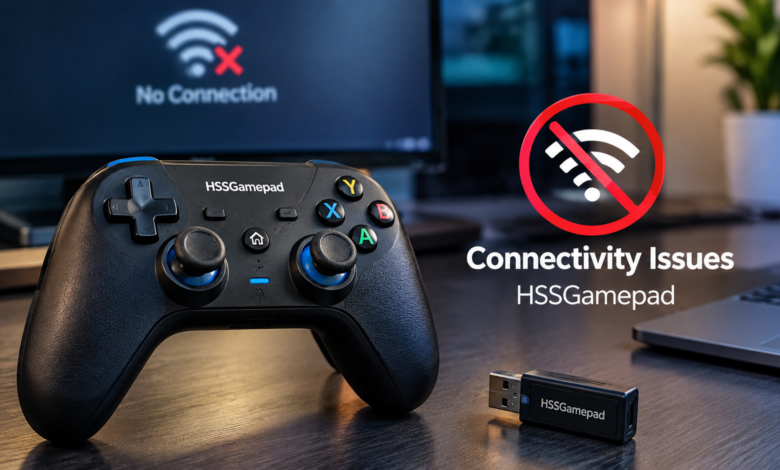
Gaming is much more enjoyable when your controller responds instantly and stays connected throughout the session. Connectivity Issues HSSGamepad However, connection problems can quickly turn a smooth gaming experience into a frustrating one. If you are searching for solutions to connectivity issues hssgamepad, you are probably dealing with problems such as a controller that will not pair, unexpected disconnections, input delays, or a device that is not recognized by your computer or gaming system.
Connectivity problems can happen for several reasons. Sometimes the issue is as simple as a low battery or an inactive Bluetooth connection. In other situations, outdated drivers, incorrect settings, wireless interference, or compatibility problems may be responsible. The good news is that most common controller connection issues can be diagnosed with a few practical troubleshooting steps.
This guide explains the most common causes of HSSGamepad connectivity issues and provides straightforward ways to identify and resolve them.
What Can Cause Connectivity Issues HSSGamepad?
The first step in solving a controller problem is understanding what might be causing it. Connectivity Issues HSSGamepad A gamepad depends on several components working together, including its power source, connection method, operating system, drivers, and the game itself. A problem with any one of these areas can affect connectivity.
One common cause is insufficient power. Connectivity Issues HSSGamepad Wireless controllers may appear to turn on while still having too little battery power to maintain a stable connection. When the battery becomes weak, the controller may repeatedly disconnect or experience noticeable input delays.
Another possible cause is interference. Bluetooth and other wireless technologies operate over radio frequencies that can become crowded when several nearby devices are active. Wireless headphones, other controllers, smartphones, Wi-Fi equipment, and USB devices can sometimes contribute to connection instability.
Software can also be responsible. Connectivity Issues HSSGamepad An operating system may not properly recognize the gamepad if its drivers are outdated or if the controller has been configured incorrectly. In some cases, the controller connects successfully but is not recognized inside a particular game because the game uses a different input standard.
Check the HSSGamepad Power and Battery First
Before changing complicated settings, check the simplest possibility: power. If you are experiencing connectivity issues hssgamepad, make sure the controller has enough battery charge. Connectivity Issues HSSGamepad A low battery can produce symptoms that look like Bluetooth or driver problems.
Connect the controller to a reliable charging source and allow it to charge properly. If the device has an indicator light, pay attention to how the light behaves while charging and when you attempt to connect it. An unusual indicator pattern can provide useful information about the controller’s current state.
If the controller uses replaceable batteries, try a fresh set rather than assuming the existing batteries still have enough power. A controller can sometimes power on with weak batteries but fail to maintain a reliable wireless connection.
Restart Both the Controller and Gaming Device
A simple restart can solve temporary communication problems between a gamepad and the device it is connected to. Connectivity Issues HSSGamepad This is particularly useful when the controller worked previously but suddenly stopped responding.
Turn off the HSSGamepad and completely close the game you are playing. If possible, restart the computer, console, or other host device as well. After restarting, wait until the operating system has fully loaded before attempting to connect the controller again.
This process clears temporary software states and can refresh wireless services. Although restarting may sound basic, it is often one of the fastest ways to eliminate a temporary connection problem.
Reconnect the Controller Through Bluetooth
If you are using a wireless connection, removing the existing pairing and creating a new one can resolve several common issues. Sometimes the operating system remembers an old connection state that prevents the controller from pairing correctly.
Open your device’s Bluetooth settings and locate the HSSGamepad if it appears in the list of previously connected devices. Remove or forget the controller, then switch Bluetooth off and back on.
Put the gamepad into its appropriate pairing mode and search for available Bluetooth devices again. When the controller appears, select it and wait for the pairing process to complete. Connectivity Issues HSSGamepad Once connected, test the buttons and analog sticks before opening a game.
Keep the Controller Close to the Device
Wireless range is another important factor when troubleshooting connectivity issues hssgamepad. Even if a controller technically supports a certain wireless range, the practical distance can be reduced by walls, furniture, metal objects, and electronic interference.
For testing purposes, sit relatively close to the computer or gaming device. Avoid placing the controller behind large objects or inside areas where the wireless signal could be obstructed.
If the connection becomes stable when you move closer, distance or interference may be contributing to the issue. Connectivity Issues HSSGamepad You can then experiment with the placement of the host device and nearby electronics to find a more reliable setup.
Reduce Wireless Interference
Wireless interference can be difficult to identify because it does not always cause a complete disconnection. Sometimes the controller remains connected but feels delayed, skips inputs, or temporarily stops responding.
Try disconnecting unnecessary wireless devices from the nearby area. If you have several Bluetooth accessories connected simultaneously, temporarily disable the ones you do not need.
You can also move other electronic devices farther away from the controller and computer. The goal is not necessarily to remove every wireless device permanently, but to determine whether another device is affecting the connection.
If the controller works normally after reducing nearby wireless activity, you have a useful clue about the source of the problem.
Check Whether Your Operating System Recognizes the Gamepad
A controller can be connected successfully but still fail to work inside a game. Connectivity Issues HSSGamepad This usually means the problem may be related to recognition or input configuration rather than the physical wireless connection.
On a computer, check the operating system’s connected devices or controller settings. Confirm that the HSSGamepad appears as an available input device.
If the operating system does not recognize it at all, the problem could involve drivers, compatibility, the USB connection, Bluetooth services, or the controller itself. Connectivity Issues HSSGamepad If the operating system recognizes the gamepad but the game does not, investigate the game’s controller configuration next.
This distinction is important because it prevents you from repeatedly changing Bluetooth settings when the actual problem is inside the game’s input configuration.
Update Drivers and System Software
Outdated drivers can contribute to controller recognition and connectivity problems. Connectivity Issues HSSGamepad Operating systems regularly receive updates that improve hardware compatibility, Bluetooth performance, and input-device support.
Check whether your computer has pending system updates. If the HSSGamepad requires a specific driver or software package, make sure you are using a legitimate and compatible version.
Avoid downloading random drivers from unfamiliar websites. Incorrect drivers can create additional problems and may introduce unnecessary security risks. When possible, use the operating system’s built-in driver update functionality or the controller manufacturer’s official support resources.
After updating drivers or system software, restart the computer and test the gamepad again.
Try a Wired Connection When Available
If your HSSGamepad supports wired operation, connecting it with a compatible USB cable can help identify whether the problem is specifically related to wireless connectivity.
A stable wired connection suggests that the controller itself may be functioning correctly while the wireless connection requires further troubleshooting. Connectivity Issues HSSGamepad On the other hand, if the gamepad fails to work even when connected by cable, the issue may involve the controller, USB port, drivers, or software configuration.
Make sure the USB cable supports data transfer if the controller requires data communication. Some cables are designed primarily for charging and may not provide the necessary data connection.
Testing multiple USB ports can also be useful, especially if the controller is not being recognized by the computer.
Check the Game’s Controller Settings
Sometimes the controller is perfectly connected, but the game is configured to use another input device. This can make it appear as though the HSSGamepad has a connectivity problem.
Open the game’s controller or input settings and check whether a gamepad is enabled. Some games allow users to manually select their preferred controller, while others automatically detect available input devices.
You may also need to check button mapping. If the game recognizes the controller but certain buttons do not perform the expected actions, the issue could be a configuration problem rather than a connection failure.
Testing the controller in another compatible game can help confirm this. If it works correctly elsewhere, the original game’s settings deserve closer attention.
Reset the Controller If Problems Continue
If standard troubleshooting does not solve the problem, a controller reset may be worth considering if the model provides an official reset procedure.
A reset can clear stored pairing information or temporary configuration problems. However, the exact procedure depends on the specific controller design, so you should use the instructions intended for your particular HSSGamepad model.
After resetting the controller, you may need to pair it with the host device again. Connectivity Issues HSSGamepad Treat the reset as a later troubleshooting step rather than the first solution, because it can remove existing connection settings.
When Hardware Could Be the Problem
Not every connectivity problem is caused by software. Physical damage, a failing battery, a damaged USB port, or internal wireless hardware problems can also cause repeated disconnections.
Look for visible signs of damage and test the controller with another compatible device if possible. If the same behavior occurs across multiple devices, that makes a hardware-related issue more plausible.
Similarly, if the controller only works when the cable is positioned in a particular way, the cable or port may be damaged. Avoid forcing connectors or continuing to use visibly damaged hardware.
How to Prevent Future HSSGamepad Connectivity Problems
Once you have solved the issue, a few simple habits can help maintain a stable connection. Keep the controller adequately charged, install system updates regularly, and avoid unnecessary wireless congestion around your gaming setup.
It is also useful to disconnect old Bluetooth devices that you no longer use. Keeping your device list organized can make troubleshooting easier and reduce confusion when several similar devices appear.
When possible, use reliable cables and avoid repeatedly bending or pulling USB connectors. Proper storage also helps protect the controller from physical damage and extreme environmental conditions.
Final Thoughts on Connectivity Issues HSSGamepad
Dealing with connectivity issues hssgamepad can be frustrating, but the problem is often easier to diagnose than it first appears. Start with the basics: check the battery, restart the controller and host device, verify Bluetooth pairing, and test the controller from a short distance.
If those steps do not help, move toward software troubleshooting. Check operating-system recognition, update relevant drivers, review the game’s input settings, and test a wired connection if one is available. These steps can help separate a wireless problem from a software or hardware problem.
The most important thing is to troubleshoot one factor at a time. Changing several settings simultaneously can make it difficult to identify what actually fixed the problem. By working through the possibilities systematically, you can usually narrow down the cause and get back to gaming with a more stable controller connection.





One Comment